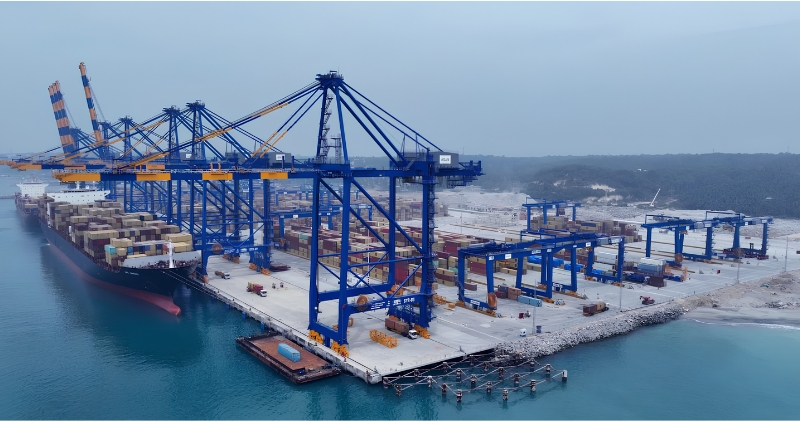
Import-Export Operations Begin at Vizhinjam Port: India’s Reliance on Foreign Transshipment Hubs to Decrease; How Much is Adani Investing?
Import-export (EXIM) operations have commenced at Kerala’s Vizhinjam Port. The Adani Group is set to invest ₹30,000 crore in this project. The operations were launched in the presence of dignitaries, including Kerala Chief Minister V.D. Satheesan and Industries Minister P.K. Kunhalikutty. Chief Minister Satheesan described it as a “moment of pride,” stating that Vizhinjam is now a gateway to the world. He emphasized maximizing the benefits of this opportunity through ‘Mission Samudra’.
What are the benefits of proximity to international shipping routes?
Following the launch of EXIM operations at Vizhinjam Port, the Chief Minister announced that the government would allocate ₹3,200 crore for land acquisition for the ring road. Ashwani Gupta, CEO of Adani Ports and Special Economic Zone Limited, stated that this new gateway connects India’s aspirations with global markets. He also linked the port to India’s self-reliance and global competitiveness.
Currently, over 75% of India’s container transshipment cargo is handled by foreign ports, which drives up logistics costs. Vizhinjam’s geographical location and natural draft of 18–20 meters enable it to handle massive Ultra-Large Container Vessels. It is situated just 10 nautical miles away from major international shipping routes.
How much is the Adani Group investing, and what is its contribution to capacity expansion?
The Adani Group’s total investment in the Vizhinjam project will reach ₹30,000 crore. An expansion worth ₹16,000 crore will be undertaken in the second phase. This will increase the port’s annual capacity to 5.7 million TEUs (Twenty-foot Equivalent Units). Infrastructure such as a 1,200-meter container berth, permanent rail connectivity, and a logistics park will be added. The target is to complete the development of this entire phase by December 2028.
What is the impact on trade and employment?
Commercial operations at Vizhinjam commenced on December 3, 2024. Since then, the port has handled over 2.3 million TEUs of cargo and 1,100 vessels, including more than 80 ultra-large container vessels. These operations will provide businesses in Kerala, Tamil Nadu, and Karnataka with direct access to international shipping networks. This will boost the competitiveness of manufacturing hubs such as Bengaluru (Karnataka), and Coimbatore and Tiruppur (Tamil Nadu). The development is expected to generate over 5,000 direct and indirect jobs.