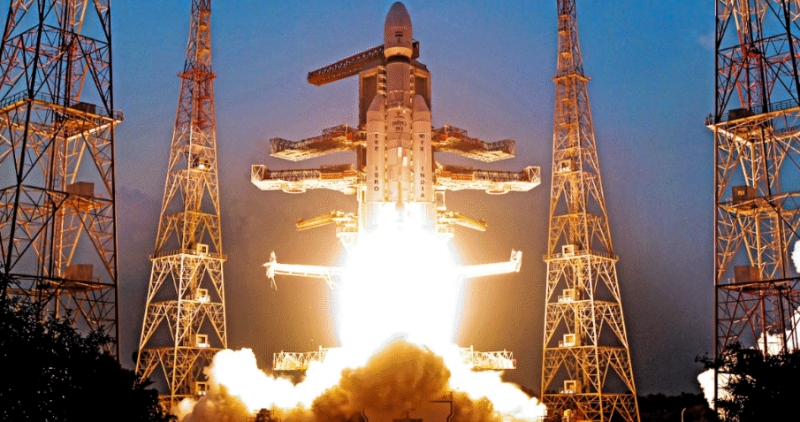
ISRO achieves major success, launches country’s heaviest communications satellite, CMS-03
The Indian Space Research Organization (ISRO) has once again proven its expertise in satellite launches. The country’s heaviest communications satellite, CMS-03, was launched on Sunday from the Satish Dhawan Space Center in Sriharikota, Andhra Pradesh. The satellite weighs approximately 4,410 kilograms.
Prime Minister Narendra Modi congratulated ISRO on this success. The SRO stated that the satellite, mounted on a 43.5-meter-long LVM3-M5 rocket, will separate after a 16-20-minute flight, reaching an altitude of approximately 180 kilometers. This multi-band communications satellite will provide services to India and the oceanic region. This is the heaviest communications satellite launched from India into geosynchronous transfer orbit (GTO). Following the launch, ISRO Chairman V. Narayanan described the satellite as “Baahubali.”
The LVM3 (Launch Vehicle Mark-3) is a three-stage launch vehicle. It consists of two solid motor strap-ons, a liquid propellant core stage, and a cryogenic stage. This heavy-duty launch vehicle allows ISRO to launch heavy communication satellites into GTO. This is the fifth operational flight of this launch vehicle. ISRO plans to use the human-rated LVM3 rocket as the launch vehicle for Gaganyaan, the country’s first mission to send astronauts into space. This launch vehicle will be called HRLV. Recently, ISRO also successfully launched the Earth imaging satellite NISAR from Sriharikota. This satellite was developed in collaboration with the US space agency NASA. NISAR (NASA-ISRO Synthetic Aperture Radar Satellite) was launched using a pickup truck-sized spacecraft. The satellite’s dual-frequency radar will orbit the Earth 14 times a day. This will allow scanning of all land and ice surfaces on Earth every 12 days.
The Gaganyaan mission is scheduled to launch in 2027. Approximately 90 percent of the work for this mission has been completed. Three uncrewed test flights will be conducted before this, and only then will the flight be declared ready for humans. With the success of this mission, India will join a select group of countries that have developed human spaceflight on their own.