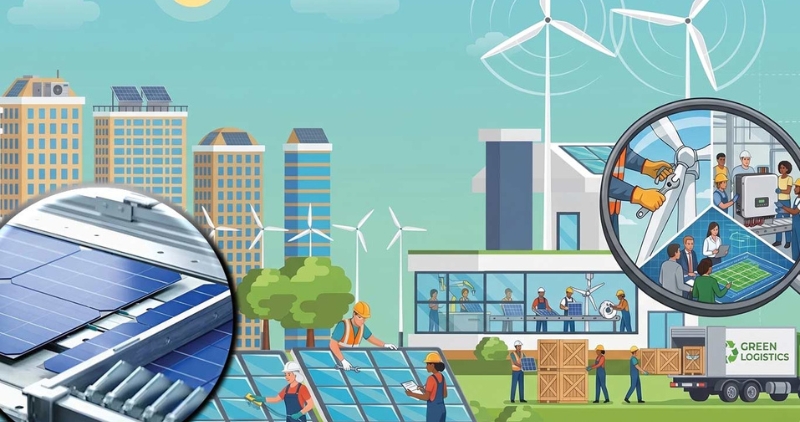
Clean Energy to Drive Major Job Growth; 4.4 Million Jobs Projected by 2030
India’s strides toward its clean energy goals are set to play a pivotal role in boosting employment in the coming years. According to a new report by the Council on Energy, Environment and Water (CEEW) and the Natural Resources Defense Council (NRDC) India, the rapid expansion of clean energy in the country could generate over 4.4 million jobs by 2030. This study was prepared under the guidance of the Ministry of New and Renewable Energy (MNRE). The report indicates that the rooftop solar sector is likely to generate the highest number of jobs during this period, accounting for approximately 43 percent of the total employment created in the clean energy sector.
Employment Opportunities Across Urban and Rural Areas
The study highlights that distributed renewable energy projects generate more employment compared to large-scale solar or wind projects. Specifically, rooftop solar projects generate about 45 FTE-year jobs per megawatt, whereas ground-mounted solar projects and wind energy projects generate 1 and 0.6 FTE-year jobs per megawatt, respectively. The growth of rooftop solar will expand employment opportunities not only in urban areas but also in semi-urban and rural regions. This will directly benefit farmers, small entrepreneurs, and local workers while strengthening domestic supply chains. According to the study, approximately 1.3 million additional jobs could be created in operations, maintenance, and manufacturing activities.
6.5 Lakh New Jobs Created Over the Last Three Years
According to the report, more than 650,000 (6.5 lakh) jobs were created across various segments of the clean energy sector between the financial years 2023 and 2026. The rooftop solar sector made the largest contribution, accounting for 62 percent of the total new jobs generated. Additionally, the PM-KUSUM scheme contributed 16.3%, the biomass energy sector 12.6%, and ground-mounted solar projects accounted for approximately 6%.
Focus on Skill Development and Training
According to the report, investment alone will not suffice to ensure the success of programs such as India’s 500 GW non-fossil fuel capacity target and the National Green Hydrogen Mission. Developing a skilled workforce on a large scale will also be essential. Experts state that the government, industry, and training institutions must collaborate on skill development, vocational training, and job creation.