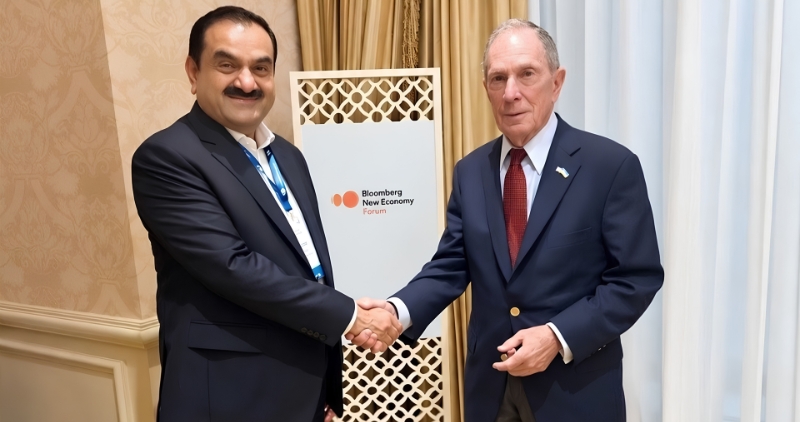
Gautam Adani meets Michael Bloomberg: Stresses that the burden of green energy must not fall on the common public, nor should it hinder industrial momentum.
During the ‘Bloomberg New Energy Forum’ held in New Delhi, Gautam Adani, Chairman of the prominent Adani Group, met with American businessman Michael Bloomberg. Following this meeting, the Adani Group Chairman made a significant observation regarding the trajectory of India’s energy transition. In a post shared on social media, Gautam Adani stated that the entire process of reducing carbon emissions in India must be anchored in an affordable, reliable, and balanced power supply. He cautioned that the shift toward clean energy should not lead to an increase in electricity costs for ordinary households, nor should it slow down the nation’s industrial progress.
What is Gautam Adani’s primary warning regarding the energy transition?
Discussing global approaches to adopting green energy, Gautam Adani remarked that reducing carbon emissions cannot merely become an “ideological mandate” that places energy beyond the reach of ordinary citizens, forces factories to shut down, or stifles the development of the Global South.
Emphasis on reducing the ‘green premium’: According to Adani, the most critical requirement is to lower the ‘green premium’—the additional cost associated with adopting green energy.
Synergy of three forces: He noted that genuine progress is only possible when capital, policy, and execution work in tandem. Their collective goal should be to drive down the green premium until clean energy becomes, indisputably, the most affordable and superior option.
Reliance on legacy systems: Furthermore, he warned of the risks inherent in continued dependence on legacy energy systems amidst climate-related uncertainties.
What are the four essential elements for nation-building and infrastructure development? Industrialist Adani emphasized that India urgently needs to expand its power supply, industrial capacity, and digital access to drive economic growth and improve living standards.
Beyond physical assets: He noted that infrastructure is not limited to physical structures—such as ports, transmission corridors, green hydrogen plants, and computing facilities—but also relies equally on reliable data, accountable institutions, and effective governance.
Four essential pillars of nation-building: Adani stated that true nation-building requires four key forces: patient capital, physical execution, transparent governance, and capable local leadership.
The true measure of infrastructure: He argued that the ultimate assessment of infrastructure should not be based on the assets created, but rather on what people are able to achieve through them.
Key discussions on the Dharavi redevelopment and urban development: In a meeting with Michael Bloomberg, in addition to energy, there were in-depth discussions on artificial intelligence (AI), advanced manufacturing, green infrastructure, and urban development.
A people-centric model for the Dharavi project: Highlighting the Dharavi redevelopment project in Mumbai, Adani remarked that its success should not be measured by the scale of real estate developed, but by the improvements in the living standards and livelihoods of its residents.