After Maruti, Tata and Hyundai to Raise Car Prices; Decision Driven by Rising Manufacturing Costs; New Prices Effective from December 1
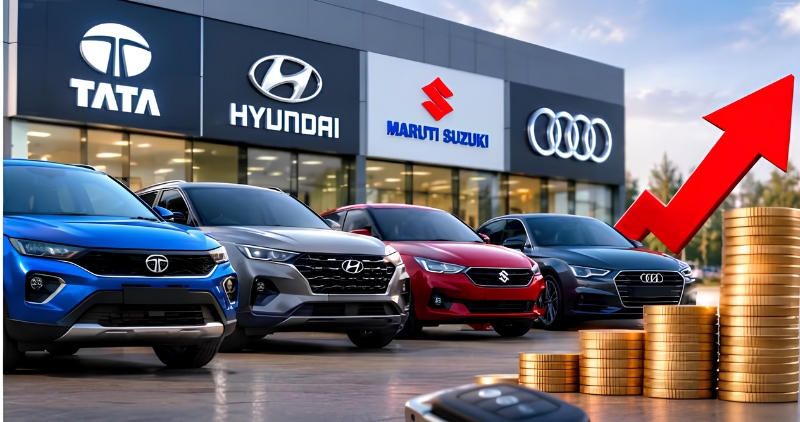
Following Maruti, Tata and Hyundai have announced price hikes for their vehicles, effective December 1. Maruti Suzuki had already increased prices for select models on November 22. The companies have taken this decision due to rising ‘input costs’—the expenses associated with the materials and components used to manufacture vehicles.
‘Input cost’ refers to the total expenditure incurred on raw materials—such as steel, aluminium, copper, plastic, rubber, and electronic components—as well as labour and transportation costs required to build a vehicle.
When the costs of these elements rise, company profit margins shrink; to compensate for this, manufacturers raise the prices of their vehicles.
Tata Cars to Become 0.5% More Expensive from December 1
Tata Motors has decided to increase the prices of all its passenger vehicles, effective December 1. The company stated that prices across its entire range will rise by an average of 0.5%. This increase will apply to petrol, diesel, and electric vehicle (EV) models alike.
Select Hyundai Models to See Price Hikes of Up to ₹8,000
Hyundai has also announced a price increase for its vehicles, effective December 1. However, the hike does not apply to the entire lineup.
The increase will be limited to specific models and particular trims (variants). Depending on the model and variant, the price of Hyundai vehicles will increase by up to a maximum of ₹8,000.
Decision Prompted by Rising Manufacturing Costs
Both companies have announced these price hikes shortly after witnessing strong vehicle sales during the festive season. Tata Motors and Hyundai state that production costs are continuously rising due to the increasing price of raw materials used in vehicle manufacturing.
Until now, both companies had been absorbing a large portion of these additional costs themselves; however, it has now become necessary to pass a small fraction of this burden on to the customers.
Maruti raises prices for the fourth time this year
Just before Tata and Hyundai, the country’s largest car manufacturer, Maruti Suzuki, also increased the prices of select models by an average of 0.31%. These new, higher prices came into effect on November 22, though the company has not yet disclosed the specific price adjustments for individual models.
This marks the fourth time this year that Maruti has raised its prices—previous hikes occurred in June, August, and September. The company notes that it is passing on only a small portion of the increased costs to ensure that the financial burden on customers remains limited.
Companies raise prices despite the challenge of maintaining sales momentum
Following the end of the festive season, automobile companies are striving to sustain the pace of car sales in the market.
Nevertheless, the persistent price hikes by major manufacturers indicate that the pressure from rising input costs—the costs associated with vehicle production—has yet to subside.
What is the difference between an ICE vehicle and an EV?
Internal Combustion Engine (ICE) vehicle: A vehicle that runs on fuel such as petrol or diesel.
Electric Vehicle (EV): A vehicle that operates using a battery and an electric motor.
What is a ‘trim’?
Different versions of the same car model, featuring varying specifications, are referred to as ‘trims’ or ‘variants’—for example, base models, mid-range models, and top-end models.