A Leap in the Defence Sector: Target of ₹3 Lakh Crore by 2029; Exports and Indigenous Production to Drive Momentum
India’s defence industry is expected to grow rapidly over the next few years. According to a report by CareEdge Ratings, defence production—valued at ₹1.78 lakh crore in the 2025-26 fiscal year—could rise to ₹3 lakh crore by the 2028-29 fiscal year. A Compound Annual Growth Rate (CAGR) of approximately 19 percent is projected for this period.
Experts state that government policies such as ‘Make in India’ and *Atmanirbhar Bharat* (Self-Reliant India), along with consistent increases in the defence budget, an emphasis on domestic production, and growing private sector participation, are propelling this sector to new heights.
Indigenous Production to Strengthen the Defence Industry
Pritesh Rathi, Associate Director at CareEdge Ratings, notes that India’s defence sector is undergoing a major transformation. The government aims to raise defence production to ₹3 lakh crore by 2029. By prioritizing domestic procurement, expanding production capacity, and maintaining consistent policy support, India will further strengthen its position in the global defence supply chain.
Reduced Import Dependency and Increased Focus on New Technology
According to defence expert Admiral Santosh Gangawat, India has made significant strides in domestic defence manufacturing following the government’s move to increase the defence budget and promote ‘Make in India.’ This has reduced reliance on imports for weaponry and defence equipment.
However, India still imports state-of-the-art defence platforms and technologies from select nations. While dependence on Russia has decreased compared to the past, defence cooperation with countries like France and Israel has expanded. India is leveraging the modern technology acquired from these nations to bolster its domestic defence industry.
World’s Second-Largest Arms Importer
According to the report, India has remained the world’s second-largest arms importer between 2012 and 2025, accounting for approximately 8.2 percent of global arms imports. Nevertheless, reliance on foreign suppliers has declined in recent years. A decline of approximately four percent in defense imports was recorded during the 2021–25 period compared to 2016–20. Meanwhile, Russia’s share of India’s defense imports dropped from around 70 percent in 2011–15 to approximately 40 percent in 2021–25. The primary reason for this shift is the increasing diversification of defense procurement involving France and other nations.
Defense Exports Set a New Record
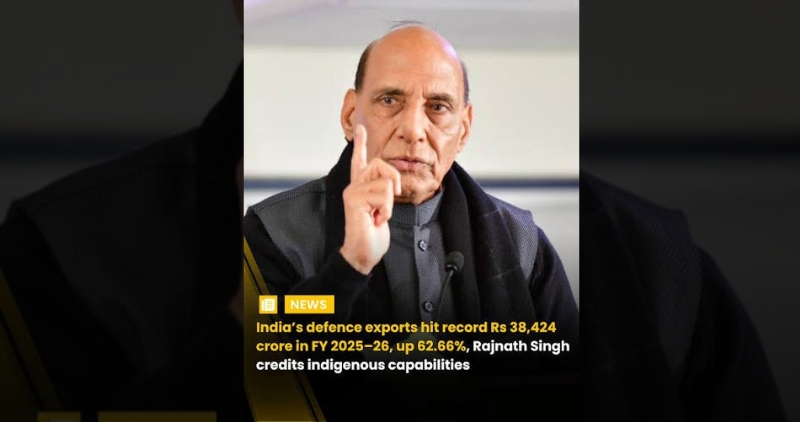
India’s defense exports are also consistently scaling new heights. In the 2026 fiscal year, defense exports rose to a record ₹38,424 crore, marking a 62.66 percent increase over the previous fiscal year. Defense Public Sector Undertakings (DPSUs) accounted for 54.84 percent of this total, while the private sector contributed 45.16 percent. The number of defense exporters has also risen from 128 to 145. Indian defense equipment is now being exported to over 80 countries, with Myanmar, the Philippines, and Armenia being key destinations.
Aiming to Become a Major Global Defense Exporter by 2047
Experts believe that ease of doing business, policies promoting production, and investments in Research and Development (R&D) will lend new strength to India’s defense industry. According to Pulkit Agarwal, Director at CareEdge Ratings, the global acceptance of Indian defense products is steadily growing. Driven by enhanced policy support, shifting geopolitical dynamics, and investments in new technologies, India is poised to further strengthen its competitiveness in the global defense market.