AI Disrupts Mobile Market: A Major Blow to Chinese Brands in India
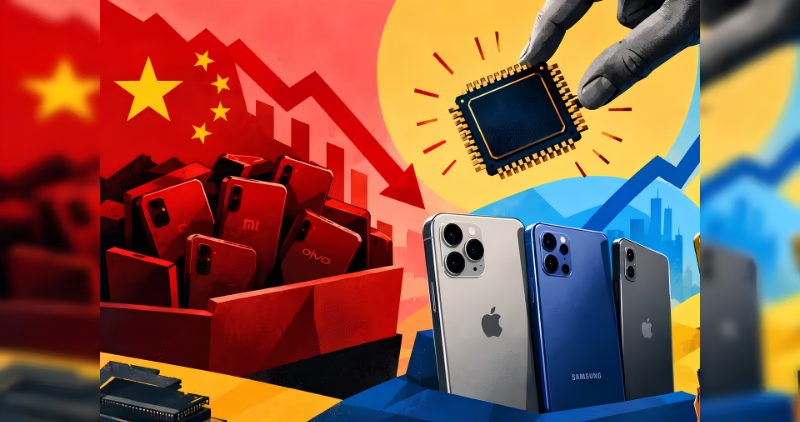
Chinese smartphone companies are facing mounting challenges in India. According to an exclusive report by Moneycontrol, rising prices of memory chips—a key component in mobile manufacturing—are driving up the cost of smartphones. This has hit the budget-phone segment the hardest. As prices climb, consumer demand is softening, leading to a decline in the market share of Chinese brands, while companies like Samsung are gaining ground. Data indicates that the Indian smartphone market recorded its weakest third quarter in a decade during the July–September 2026 period.
Chinese Brands’ Market Share Drops from 75% to 68%
Research firm Counterpoint reports that the combined market share of Chinese smartphone brands in India has fallen from 75% a year ago to approximately 68%. Meanwhile, Omdia notes that total smartphone shipments in the September quarter saw a 26% year-on-year decline, falling to 35.8 million units. This is a significant setback for Chinese firms, whose strong foothold in the Indian market has largely been built on the back of affordable smartphones. Rising costs are now making it increasingly difficult for these companies to sell devices at lower price points.
Why Is AI Driving Up the Cost of Memory Chips?
A major factor behind the rising cost of smartphones is the demand fueled by Artificial Intelligence (AI). The development of large-scale AI data centers has created a need for high-capacity memory chips. Companies such as Samsung Electronics, SK Hynix, and Micron are prioritizing the production of chips for AI data centers—products that offer higher profit margins. This has strained the availability of DRAM and NAND memory, which are typically used in standard smartphones. According to TrendForce, memory components previously accounted for about 10–15% of the total manufacturing cost of a smartphone. In some mainstream smartphones, this figure has risen to 30–40%. Consequently, it is becoming difficult for companies to maintain their previous price points.
Decline in sales for Vivo, Oppo, and Xiaomi
According to Omdia, a significant decline in shipments by Chinese companies was recorded in the September quarter, as follows:
Vivo: 6.4 million units (a 34% decline).
Oppo: 4.9 million units (a 24% decline).
Xiaomi: 4.7 million units (a 28% decline).
Meanwhile, Samsung took the top spot with 6.7 million units shipped. However, experts believe that the decline among Chinese companies is not solely due to shifting consumer preferences; it is also driven by rising costs and weak demand.
An opportunity for Indian companies
The shrinking market share of Chinese companies could prove beneficial for Indian mobile brands. According to Counterpoint, the total market share of domestic companies has risen from 2% in the third quarter of last year to 7% this year. Companies like Lava have an opportunity to expand in the market for affordable 4G and 5G phones. Success, however, will require a robust distribution network, sufficient stock, and better after-sales service.
Companies shifting focus toward higher-priced phones
To cope with rising costs, Chinese companies are reducing their range of budget-friendly models and focusing instead on more expensive smartphones. Some are opting to reduce memory capacity in certain devices while simultaneously introducing premium models equipped with advanced features like enhanced cameras and AI capabilities. According to IDC, shipments of smartphones priced between $400 and $600 have seen a 60% year-on-year increase.
Phone prices may rise further in the coming months. This will particularly affect consumers looking to purchase a new smartphone on a limited budget. Under these circumstances, maintaining their long-standing grip on the Indian market will pose a major challenge for Chinese companies.