China’s plane takes its first international flight! Will the ‘Dragon’ disrupt the Boeing-Airbus duopoly in the aviation industry?
Achieving a major milestone, China’s aviation industry has deployed its domestically produced C919 passenger jet for its first international commercial flight. This Air China aircraft departed from Beijing bound for Ulaanbaatar, the capital of Mongolia, landing there after a flight of approximately two hours. With this flight, China has taken a significant step toward expanding the reach of the C919 beyond its borders. The big question now is whether this Chinese aircraft can challenge the long-standing dominance of Boeing and Airbus in the global commercial aviation market.
A direct rival to the Boeing 737 MAX and Airbus A320neo
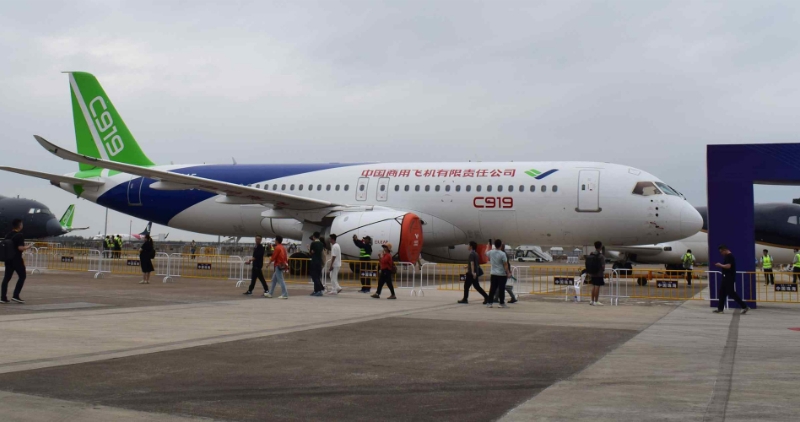
The C919 is a single-aisle, narrow-body passenger aircraft with a seating capacity of around 174 passengers. It has been designed to compete in the same market segment as aircraft like the Boeing 737 MAX and Airbus A320neo. Air China plans to operate daily flights between Beijing and Ulaanbaatar. This flight is particularly significant for China as it offers the Commercial Aircraft Corporation of China (COMAC) an opportunity to expand the presence of its aircraft in the international market. COMAC aims to establish a foothold in the global aviation industry alongside meeting China’s domestic requirements.
However, the C919 faces several major challenges
The C919’s biggest weakness at present is its reliance on a foreign supply chain. The aircraft’s engines are manufactured by CFM International, a joint venture between the US-based GE Aerospace and France’s Safran Aircraft Engines. In other words, China’s ‘indigenous’ aircraft does not yet rely entirely on domestic technology. Another major challenge is international certification; the C919 has not yet received certification from key aviation regulators in the United States and Europe. Consequently, the scope for sales and operations in many major foreign markets remains limited. The pace of production is also a concern for COMAC. According to analysts, COMAC had delivered a total of approximately 32 C919s by the end of 2025, whereas Airbus delivered nearly 100 narrow-body aircraft to China in 2025 alone. In the first half of 2026, COMAC delivered another eight C919 aircraft.
Building Trust is as Crucial as Manufacturing Aircraft
Experts believe that simply building a good aircraft will not be enough to challenge Boeing and Airbus. Airlines need to be assured that long-term availability of spare parts, maintenance, and 24/7 in-service support will be guaranteed. Aircraft manufacturing is an incredibly complex process, and even a minor disruption in the supply chain can halt the delivery of an entire aircraft. Everything—from engines down to small components like fasteners—must be available on time.
Nevertheless, the C919 represents a major achievement for China’s aerospace industry. Only a handful of manufacturers worldwide possess the capability to integrate thousands of components, systems, and software to make such a large aircraft function effectively. Therefore, while overtaking Boeing and Airbus on the international stage remains a distant prospect for the C919 for now, COMAC could certainly emerge as a third major player over time, driven by China’s domestic market and its expanding international footprint.